CRM
Data Passport
The "Data Sovereignty" Standoff & The Rise of Hyper-Localism
CRM
Data Passport
Have you ever stopped to ask who actually "owns" your guest?
For decades, the hospitality industry fought a bitter tug-of-war with Online Travel Agencies (OTAs) over the "Direct Relationship." If a guest booked through a third party, you got the room revenue, but the platform kept the behavioral data. Today, the battle lines have shifted entirely. The standoff is no longer just between the hotel and the OTA. The new power player is the guest's own personal technology, and the battlefield is "Data Sovereignty."
Is Your CRM an Asset or a Liability?
We’ve reached a boiling point in how commercial leaders view guest information. As autonomous booking platforms and personal AI assistants become exponentially more powerful, the traditional Customer Relationship Management (CRM) system is facing an existential crisis.
Think about how you currently operate. You collect an email, track room temperature preferences, and log dining history in a centralized database, treating it as your marketing goldmine. But what happens when the hyper-aware 2026 traveler decides they no longer want you holding that information indefinitely?
A massive database of "owned" guest data is rapidly transitioning from a commercial asset into a severe compliance liability. If your data infrastructure isn't portable, instantly updateable, and strictly permission-based, the "New Guest" won't just abandon their cart—their AI travel agent will actively filter your property out of their consideration set.
The Arrival of the "Data Passport"
We are watching the rapid acceleration of Self-Sovereign Identity (SSI) frameworks. The modern traveler is exhausted from the friction of creating a new profile, entering their credit card, and re-stating their dietary requirements every single time they book a new brand.
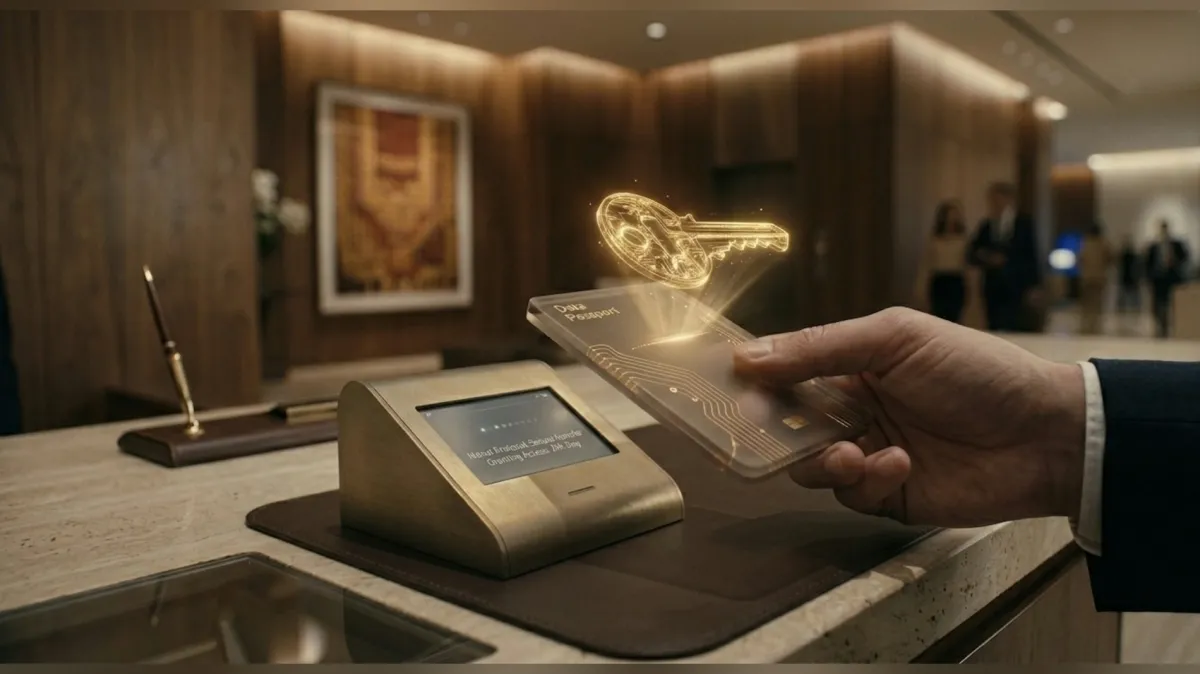
Instead, the industry is moving toward encrypted "Data Passports" held securely in the guest's own digital wallet. When their AI agent books a room, it doesn't hand over the guest's permanent file. It grants your hotel's core engine a temporary, cryptographic "key" to access only the specific data needed for that exact stay. The moment they check out, the permission is revoked, and the data vanishes from your servers.
Are your frontline systems ready to ask a guest's algorithm for permission to access their profile?
The Pulse Connection: Signal from the Hubs
You are reading the free executive summary. But the actual survival strategies—the exact blueprints keeping top operators from being hit with catastrophic data fines or losing the "Direct Booking" war to AI—are locked securely inside the Nexus Hospitality Vertical.
The execution gap between properties that are "guessing" and those utilizing our proprietary vendor dossiers is widening every single day. If you aren't inside the Hubs, you are operating on a 2023 playbook in a 2026 market. Here is the critical intelligence your competitors unlocked this week while you were on the outside:
• Hub 1 (The Core Engine): While most hotels are still trying to collect email addresses at the front desk, the top 1% of operators are preparing for the "Data Passport." We hosted a closed-door deep dive on Self-Sovereign Identity (SSI). If you don't know how to ask a guest's AI for permission to access their data, your CRM is already a dead asset.
• Hub 5 (Trust & Compliance): If a guest's autonomous AI bot books a $5,000 non-refundable suite and makes a mistake, who is legally liable? (Hint: The courts are ruling it's you). We issued a critical legal alert on the new "Right to be Forgotten" mandates for AI datasets. Without this intelligence, your booking engine is an unprotected legal trap.
The era of reading the news and hoping for the best is over. In 2026, the safest data to hold is the data you don't actually store, and the most dangerous strategy is inaction.