Hospitality
Intelligent Cities
Entertainment
Aviation & Airports
The Invisible Hand: Why the 2026 Travel Ecosystem Has No Room for Failure
Hospitality
Intelligent Cities
Entertainment
Aviation & Airports
In the travel industry of 2026, the highest compliment a guest can pay is silence. When the HVAC in a luxury suite hums perfectly, when the jet engine starts without a hitch, and when the theme park ride never pauses for "technical difficulties," the system is working exactly as intended.
For decades, the sector operated under a reactive "Break-Fix" model: wait for a failure, apologize to the customer, and pay a premium for an emergency repair. In 2026, that model is officially obsolete. Across the entire travel ecosystem—from hospitality and aviation to smart cities and entertainment—Predictive Maintenance (PdM) has become the invisible hand ensuring operational continuity and protecting the bottom line.
The 48-Hour Advantage: Sensing the Invisible
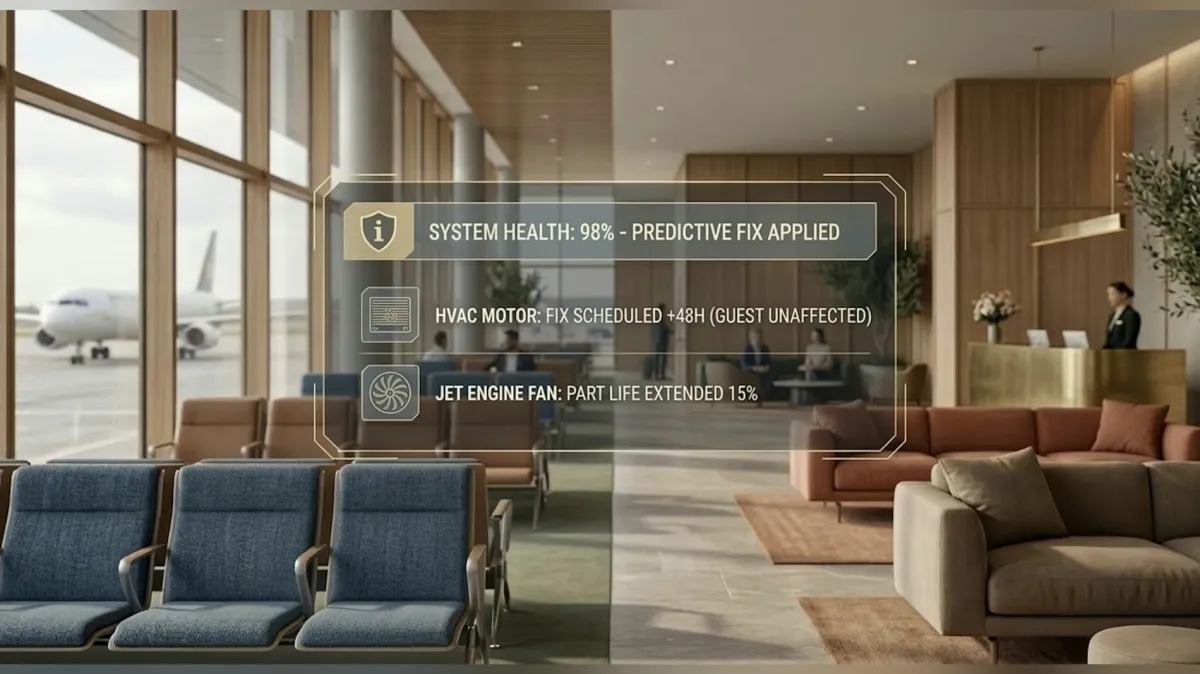
The shift is driven by a simple technological reality: IoT sensors and Digital Twins now detect anomalies long before they manifest as physical failures. Whether it is a vibration imbalance in a jet turbine or a slight temperature creep in a hotel walk-in freezer, the data flags the issue 48 to 72 hours before a human would ever notice a change in performance.
In 2026, we no longer "hope" things work; we monitor their heartbeat. This 48-hour window allows operators to schedule repairs during "trough" hours—at 3 AM when the guest is asleep or while an aircraft is at a hub for a scheduled turn. This turns a potential catastrophe into a routine adjustment that never crosses the guest's radar.
Sector Impact: Beyond the Hotel Room
While hospitality pioneered the "quiet stay," the broader travel ecosystem has scaled PdM to maintain high-stakes infrastructure where the cost of failure is astronomical:
-
Aviation & Airports: An Aircraft on Ground (AOG) event in 2026 can cost an airline upwards of $150,000 per hour in rebooking, fuel, and lost revenue. By using predictive analytics on engine components, carriers have reduced unscheduled maintenance by 35%, essentially "fixing" the flight before the passengers even board.
-
Entertainment & Theme Parks: For major attractions, "Uptime" is the primary KPI. Modern ride systems use real-time load and friction sensors to predict wheel-assembly wear. This has virtually eliminated the mid-day "evacuation," which used to cost parks thousands in "exit passes" and significant social media PR damage.
-
Intelligent Cities: Tourism hubs now apply PdM to the "last mile." Escalators in transit hubs and autonomous shuttles are monitored for mechanical fatigue, ensuring that the traveler's transition from the airport to the city center remains frictionless.
The Economic Reality: Turning Data into Savings
The move to predictive maintenance isn't just about guest satisfaction; it’s a rigorous financial strategy. The savings are found in the gap between a planned fix and an emergency intervention.
When a system fails unexpectedly, the costs go beyond the repair. You are paying for emergency labor premiums, expedited shipping for parts, and—most importantly—service recovery. In 2026, the cost of a single "comped" night or a flight voucher can outweigh the annual monitoring cost of the sensor that could have prevented the issue.
On average, travel enterprises utilizing these systems are seeing a 25% reduction in total maintenance expenditures and a 60% drop in "service recovery" costs like refunds and vouchers.
The "Break-Fix" era was defined by crisis management. The "Predictive" era is defined by Operational Excellence. For the modern travel professional—whether in the cockpit, the C-suite, or the back-of-house—the goal is the same: use data to make the complex machinery of travel so reliable that the guest forgets it exists.
In 2026, if you aren't fixing it before it breaks, you're already behind.